
THE CLIENT
KISHOR PUMPS PVT. LTD.
Kishor Pumps is an established Indian industrial pump manufacturer with a portfolio spanning sewage and submersible pumps for sewage treatment applications, horizontal industrial pumps for chemical, alkali, hot liquid, and high-pressure operations, and tank-mounted vertical pumps for industrial and chemical environments. Each pump is custom-designed per client flow and liquid requirements, across roughly 26 series and approximately 40 standard size combinations with multiple metallurgical variants.
The company services its installed base across India through a structured field operations network. Central service coordination runs out of Pune, with field engineers stationed across Pune, Satara, Chennai, Delhi, Karnataka, and Hyderabad, and a wider network of 8 Authorised Service Centres (ASCs) handling installation, commissioning, repair, refurbishment, and AMC work nationally. The installed pump base across these geographies generates a continuous flow of service requests, AMC renewals, spare part demand, and refurbishment jobs.
What Was Broken
For an operation of this scale and technical complexity, the service delivery engine was still running on email, spreadsheets, and paper. Service requests landed in a shared mailbox, got logged manually into a CRM module, and were assigned to one of 8 service centres by a single coordinator working through inbox volume every day. Field engineers filled out hard-copy service reports on site, got customer signatures by hand, and scanned them back to the coordinator. Closure happened manually once payment confirmation came through.
The same data was being entered three or four times across email, CRM, manual service report, and closure update. Engineers had no live status updates, the coordinator had no real-time visibility into ASC performance, and leadership had no clean line of sight into complaint categories, turnaround time, technician productivity, or chargeable versus non-chargeable service split. AMC scheduling was unstructured, with no automated alerts driving renewals. Spare part sales through ASCs were below contractual targets because there was no system traceability of what each centre was actually selling and servicing.
The result: missed service calls, delayed closures, no visibility into ASC performance, lost spare part revenue, and a service operation running well below the efficiency its scale should have delivered. Kishor needed the field service engine to match the engineering precision of the pumps it manufactures.
What BGA Delivered
BGA designed and implemented a unified field service and project execution platform across Zoho FSM and Zoho Projects, built specifically for Kishor Pumps’ multi-vertical pump portfolio and pan-India ASC network. The work covered the full service lifecycle from complaint intake to closure, with structured integrations into the existing CRM and a project management layer for repeatable execution.
- Centralised Service Request Intake
We configured FSM as the single intake point for every service request, replacing the manual mailbox-to-CRM-to-coordinator chain. Requests now originate via email or Zoho Form, auto-create a Request record in FSM with all key fields populated (Customer, Contact, Asset, Serial No., Priority, Address, Request Type), and trigger automated acknowledgments to both customer and internal team.
- Geolocation-Based Auto-Assignment
We built the auto-assignment logic that routes every complaint to the nearest Authorised Service Centre based on geolocation. The coordinator no longer manually triages every inbound request, and ASCs receive work in their service area without delay.
- Warranty and Cause Categorisation Framework
We configured the complaint classification architecture to separate Free (In Warranty) from Chargeable (Out of Warranty) service, with each complaint tagged against a 14-cause taxonomy covering company-related and customer-related causes. This single configuration unlocked the analytics Kishor had been missing for years.
- Estimate to Work Order Workflow
We structured the ASC-side workflow so that estimates are prepared in FSM, approved through a defined flow, and converted to Work Orders with Job Type (Installation, Repair, AMC, Refurbishment), Service Skill Level, Assigned Technician, and Expected Visit Date. Every work order links automatically to the FSM Calendar for technician visibility.
- Appointment Scheduling and Visit Management
We configured the appointment module to support distinct visit categories including Courtesy Visits (in-warranty free and out-of-warranty paid) and Commissioning Visits, with full status progression from Assigned to In Progress to Completed to Closed, and timestamps captured at every stage.
- Mobile Field Service Layer
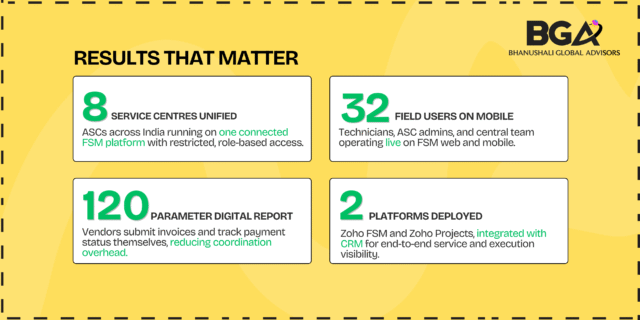
We deployed the FSM mobile app for field technicians across all 8 ASCs and 6 field engineer locations. Technicians now start and end jobs on mobile, capture time spent, log materials and parts used, and upload service reports with customer signatures directly from site. The paper-and-scan loop is gone.
- 120-Parameter Service Report Configuration
We configured the on-site service report template covering the full ~120-parameter checklist that Kishor’s engineering team uses for pump diagnostics. Every report is now structured, digitally captured, signed at site, and attached to the Work Order before closure can be triggered.
- Closure and Billing Engine
We configured the closure logic so that a Work Order can only be marked Closed once the technician submits the report, the customer signature is verified, and payment confirmation is recorded. The billing module sits inside FSM, enabling ASCs to raise invoices for services and spares directly, with payment tracking visible in centralised reports.
- AMC Scheduling and Renewal Automation
We configured AMC templates for monthly, quarterly, semi-annual, and annual maintenance plans, with each AMC record linked to a specific pump serial number. Automated reminders trigger every three months for reordering or maintenance, giving Kishor a structured renewal engine instead of reactive AMC management.
- CRM and FSM Integration Architecture
We built the bidirectional sync between Kishor’s CRM and Zoho FSM. Pump details, serial numbers, customer master, and order history flow from CRM into FSM. Service request data, closure details, and invoice information flow back into CRM for unified analytics. The two-hour sync TAT ensures field operations and customer records stay aligned.
- Role-Based Access Across Service Network
We configured the access architecture to handle 32+ users across 8 ASCs operating as a single organisation with restricted access by centre. Each user role carries its own scope: Technician access on mobile FSM only, ASC Admin access on Work Order, Billing, and Reimbursement, Central Team access on Dashboard, Analytics, and Customer Data. Duplicate email IDs are blocked at user creation to enforce identity discipline.
- Service Analytics and Performance Reporting
We delivered the reporting layer that gives leadership the visibility the manual process never could. Complaint categorisation reports across the 14-cause taxonomy. Free versus chargeable complaint analysis. Turnaround Time by service centre. Technician productivity reports. Spare parts revenue by ASC. AMC schedule and renewal dashboards.
- Zoho Projects for Internal Execution
Alongside FSM, we implemented Zoho Projects as Kishor’s single source of truth for internal project management. Pre-built project templates, pump-wise task lists, milestones, dependencies, Gantt charts for effort logging, resource workload visibility, and SLA tracking on tasks and issues replaced the spreadsheet-and-email project tracking that had been slowing cross-functional execution.
BGA Approach
This was not a typical FSM implementation. Kishor Pumps does not run a generic field service operation. The business services a 26-series industrial pump portfolio across sewage, chemical, and high-pressure applications, through an 8-centre ASC network, with a 120-parameter on-site diagnostic report that is the core of how the engineering team validates field work. A standard FSM rollout would have covered the basics and missed everything that actually makes Kishor’s service operation work.
BGA brought the right combination: deep functional understanding of field service operations, multi-location ASC governance, manufacturing service workflows, and Zoho platform depth across FSM, Projects, and CRM integration. We understood that for an industrial pump manufacturer, every service visit is a technical event, every spare part has revenue implications, every AMC renewal is a relationship to be managed, and every ASC is a P&L that needs measurement. The system had to model the engineering and commercial reality of the business, not force the service team into a generic ticketing flow.
The result: a field service operation that runs on mobile across India, captures every diagnostic parameter at the point of work, routes complaints by geography in seconds rather than hours, converts AMCs into a managed renewal engine, gives ASCs the billing and analytics layer they needed to hit spare part targets, and gives Kishor’s leadership real-time visibility into the metrics the manual process kept invisible.